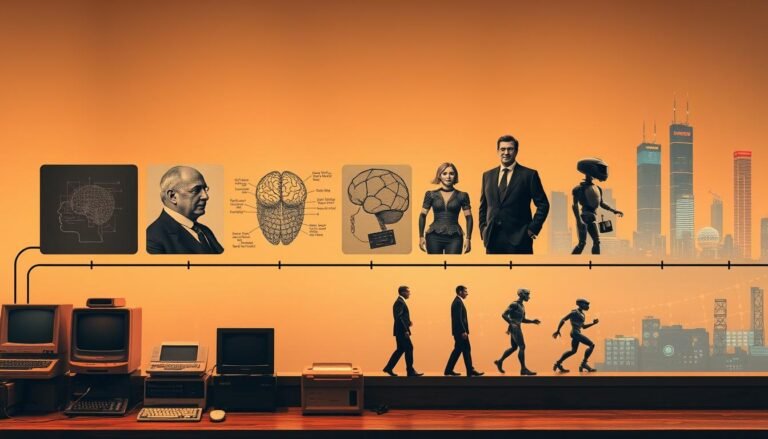
What is Artificial Intelligence in Software?
Alan Turing once asked if machines could think, sparking a long shift in how we build tools. Today, that idea has grown into code that learns, adapts, and helps people solve real problems.
The core concept ties smart algorithms to everyday apps. Modern technology turns raw data into guidance, letting systems offer expert recommendations across services you use daily.
Early systems followed fixed rules. Now, learning models mimic reasoning and change with experience. This means software can predict needs, spot patterns, and speed up decisions for businesses and consumers.
As you read on, we will unpack how these tools evolved and where they help most. Expect clear examples and practical uses that show how intelligence fuels better applications without jargon.
Defining What is Artificial Intelligence in Software
At their core, these systems fuse computation and data to reveal trends humans may miss. This short guide breaks the field into clear parts so you can follow how models learn and why data matters.
Defining the field
Artificial intelligence sits inside modern computer science and blends analytics, statistics, and software engineering. Researchers build models that learn patterns from examples rather than follow fixed instructions. This approach makes apps more adaptive and useful for real tasks.
The role of data
Data powers every step: raw records become training sets, which feed algorithms that shape model behavior. With diverse information, computers can generalize better and spot complex links across cases.
- Large, labeled sets improve accuracy over time.
- Unstructured inputs like text and images need preprocessing before learning.
- Good data governance keeps results reliable and fair.
| Item Name | Description | Calories | Price |
|---|---|---|---|
| Model Training | Converting data into predictive rules | 0 | $0 — $10k |
| Data Prep | Cleaning and labeling inputs | 0 | $500 — $5k |
| Algorithm Tuning | Adjusting parameters for accuracy | 0 | $200 — $3k |
The Core Mechanics of Intelligent Systems
At the heart of modern systems, layers of logic and probability turn raw records into timely answers.
Data acts as the base: cleaned, labeled, and fed into models that apply rules and chance to test hypotheses. These steps help a machine learn to spot patterns that mimic human perception and reasoning.
Systems use a mix of deterministic rules and probabilistic models to reduce uncertainty over time. That mix lets teams build reliable solutions for tasks like forecasting, anomaly detection, and automated routing.
| Item Name | Description | Calories | Price |
|---|---|---|---|
| Data Ingestion | Collecting and normalizing raw records | 0 | $0 — $2k |
| Probabilistic Models | Estimating outcomes when inputs vary | 0 | $1k — $6k |
| Decision Rules | Hard constraints and business logic | 0 | $500 — $3k |
| Monitoring | Tracking performance and drift | 0 | $200 — $2k |
We view these systems as nested layers. First comes data, then feature extraction, then model inference, and finally action. Each layer refines the prior one so the whole system handles change better.
Understanding Machine Learning and Deep Learning
Layered learning methods allow models to extract meaningful signals from noisy data and make fast decisions.
| Item Name | Description | Calories | Price |
|---|---|---|---|
| Supervised Training | Pairs examples with labels so models learn correct outcomes | 0 | $1k — $8k |
| Neural Network Build | Designs interconnected layers to process information and find patterns | 0 | $2k — $15k |
| Layer Tuning | Adjusts depths and weights to improve accuracy on tasks | 0 | $500 — $7k |
| Inference | Runs models to deliver fast decisions from new data | 0 | $0 — $5k |
Neural Networks
Neural networks link nodes across layers. Each node transforms inputs and passes results onward.
This chain of simple steps lets a network spot patterns inside large volumes of data.
Supervised Learning
In supervised learning, humans supply labeled examples during training so a model can predict outcomes later.
This approach suits tasks like classification and forecasting where clear answers exist.
Deep Learning Layers
Deep learning stacks many layers to extract complex features automatically.
These layers help a computer handle unstructured inputs and reduce the need for manual feature engineering.
- Simple models handle basic tasks; deep stacks handle subtle relationships.
- More layers often mean better pattern extraction, but they need more data and care during training.
Natural Language Processing and Computer Vision
Natural language processing lets a system parse speech and text so you can talk to devices as if they were helpers. These tools power voice assistants like Siri and Alexa and make translation services smoother.
| Item Name | Description | Calories | Price |
|---|---|---|---|
| Text Understanding | Natural language processing that extracts meaning from text | 0 | $1k — $8k |
| Image Recognition | Computer vision for detecting objects, faces, and scenes | 0 | $2k — $15k |
| Multimodal Fusion | Combines visual and textual data for richer responses | 0 | $3k — $20k |
Computer vision lets a machine see images and video and spot people, signs, or hazards. Common uses include facial recognition and navigation for robots or vehicles.
When combined, language processing and visual analysis bring context. Teams use deep learning on labeled data so systems can link words to images and offer clearer suggestions.
- Better interfaces through speech and text that match user intent.
- Faster recognition of visual cues for real-time tasks.
- Richer applications when analytics and learning work together.
Distinguishing Traditional AI from Generative Models
Recent models move beyond analysis and can produce new content that mirrors their training sources. This shift changes how teams use data and tools over time.
Traditional systems follow programmed rules and analyze inputs to make decisions. Generative models, by contrast, encode a compact view of training data so they can create fresh material that feels familiar.
| Item Name | Description | Calories | Price |
|---|---|---|---|
| Variational Autoencoders (VAEs) | Encode and decode to recreate samples; introduced 2013 | 0 | $1k — $10k |
| Diffusion Models | Generate images by removing noise; emerged 2014 | 0 | $2k — $15k |
| Transformers | Sequence models for long content and language tasks | 0 | $5k — $50k |
| Developer Tools | Generative applications that speed coding and design | 0 | $0 — $8k |
How Generative Models Create Content
Generative approaches train on large sets of data and learn compressed patterns. They use deep learning building blocks like neural networks to map inputs to outputs.
Their power lies in sampling from learned patterns so new content matches style and context. Developers adopt these applications to speed tasks, improve design, and keep output relevant with careful training.
A Brief History of Computational Intelligence
Early pioneers framed a test to judge machine reasoning, setting the stage for decades of work.
In 1950, Alan Turing published “Computing Machinery and Intelligence” and proposed the Imitation Game as a way to measure machine thinking.
The 1950s marked major strides as labs and universities turned thought experiments into active study. This era launched formal programs that fused logic, data and early programming.
- The history began earlier, but the 1950s brought foundational research and organization.
- The 1980s saw strong government funding and a boom in expert systems that solved narrow tasks.
- Researchers moved from symbolic rules toward learning methods over many decades.
- The field has cycled through hype and funding dips, each time returning stronger.
| Item Name | Description | Calories | Price |
|---|---|---|---|
| Turing’s Essay | Framed a practical test for machine thought | 0 | $0 — $0 |
| 1950s Labs | Organized early programs and experiments | 0 | $0 — $10k |
| 1980s Expert Systems | Commercial rules-based tools with heavy funding | 0 | $1k — $50k |
| Modern Advances | Learning-based systems that scale with data | 0 | $5k — $100k+ |
Studying this history helps you see how far the field has come and why current tools behave the way they do.
Categorizing AI by Capability and Functionality
Classifying modern systems helps teams match tools to real needs and avoid overhype.
Below we break categories into clear, usable groups so you can judge fit, risk, and benefit for projects that rely on data and learning.
Narrow versus General Intelligence
Artificial intelligence today mostly appears as narrow agents that handle specific tasks well.
These agents use machine learning and tuned models to offer excellent recognition, predictions, or automation for targeted applications.
General forms remain theoretical; most real systems focus on a well-defined goal, not broad understanding.
Reactive Machines
Reactive machines act on current inputs with no memory. They follow rules or fixed policies and do not learn over time.
IBM’s Deep Blue, a reactive machine, beat Garry Kasparov in 1997. That match shows the strength of focused design even without long-term learning.
Machine learning models add limited memory to improve behavior during a session, letting software refine predictions as new data arrives.
| Item Name | Description | Calories | Price |
|---|---|---|---|
| Reactive Machines | Rule-driven systems; no memory; fast on single tasks | 0 | $0 — $50k |
| Limited-Memory Models | Use recent data to update outputs; common in practical apps | 0 | $1k — $100k |
| Narrow Agents (ANI) | Expert at specific tasks like recognition or predictions | 0 | $5k — $200k |
| Hypothetical General Agents | Aim for broad capabilities; not yet realized commercially | 0 | $TBD |
Understanding these classes helps you assess which algorithms and systems suit your services, and where governance and testing matter most.
Key Benefits of Integrating AI into Business
Smart tools can free teams from routine tasks and let people focus on strategy and craft.
Automation reduces repetitive work across core processes, so staff spend time on higher-value projects. That shift boosts morale and raises output quality.
These solutions speed up decisions by analyzing trends and offering clear forecasts. Teams gain timely insights that keep them competitive across industries.
Streamlined processes cut human error and ensure consistent service delivery for both digital and physical operations. Organizations also respond faster during crises with real-time signals and automated playbooks.
- Scale work without linear headcount growth.
- Improve accuracy through continuous model feedback.
- Respond quickly to market shifts and operational issues.
| Item Name | Description | Calories | Price |
|---|---|---|---|
| Task Automation | Automates routine steps to free staff for creative work | 0 | $1k — $20k |
| Decision Support | Analyzes trends to help leaders make faster choices | 0 | $2k — $50k |
| Process Monitoring | Maintains consistent performance and alerts on drift | 0 | $500 — $10k |
Real World Applications Across Industries
From retail floors to factory lines, adaptive systems automate tasks and spot issues early.
| Item Name | Description | Calories | Price |
|---|---|---|---|
| Chatbots | Handle customer queries using natural language processing for faster replies | 0 | $0 — $50k |
| Fraud Detection | Machine learning and deep learning scan transaction patterns to flag risky products | 0 | $5k — $100k |
| Predictive Maintenance | Sensor data and models forecast failures to save time and costs | 0 | $1k — $75k |

Automation in Development
Generative code tools speed repetitive tasks and help modernize legacy software. Teams use these applications to produce boilerplate, test stubs, and inline suggestions.
- Chatbots and virtual assistants use language processing to handle common service requests and free staff for complex work.
- Learning models analyze transactions and flag suspicious products, protecting customers and business reputation.
- Predictive models process sensor data so teams perform maintenance before failures cost time or money.
Across industries, these solutions improve product recommendations, automate admin processes, and sharpen decisions. The result is better user experience and faster delivery of services.
Addressing Security and Operational Risks
Security gaps can turn clever systems into costly liabilities if left unchecked. You must secure data across every stage of development, from collection and training to deployment and processing.
Model drift and bias create real operational risk. Continuous monitoring of training sets keeps patterns current and avoids degraded outcomes over time.
Threat actors may target models for theft or manipulation. A compromised network or exposed algorithms can change decisions and harm customers quickly.
- Protect data with encryption, access controls, and audit logs.
- Monitor models for drift and bias; retrain when performance drops.
- Harden endpoints to prevent theft or replay attacks on the system.
- Apply governance to keep automation aligned with policy and human oversight.
| Item Name | Description | Calories | Price |
|---|---|---|---|
| Data Protection | Encryption, access controls, secure pipelines | 0 | $1k — $20k |
| Model Monitoring | Detect drift and bias; schedule retraining | 0 | $500 — $15k |
| Network Security | Endpoint hardening and theft prevention | 0 | $1k — $25k |
Strong governance and clear incident plans help you keep systems reliable and protect sensitive information. Address risks early and often to maintain trust and stable processes.
The Importance of AI Ethics and Governance
Ethics and governance steer how modern systems affect people and public trust.
AI ethics studies how to maximize benefit while cutting risks and harmful outcomes. It pulls from law, philosophy, and engineering so teams build fairer products.
Governance frameworks act as guardrails during design and deployment. They require clear roles, audit trails, and routines for monitoring model behavior over time.
- Transparency: Explainable models let users see how systems reach decisions and verify generated content.
- Fairness: Ongoing research helps spot bias and protect underrepresented groups.
- Stakeholder input: Developers, policymakers, and affected communities must shape rules together.
| Item Name | Description | Calories | Price |
|---|---|---|---|
| Data Governance | Policies for collection, labeling, retention | 0 | $1k — $20k |
| Model Audits | Regular checks for drift, bias, and safety | 0 | $500 — $15k |
| Stakeholder Board | Cross-functional group to review policy | 0 | $0 — $10k |
Career Paths and Educational Requirements
Many roles now center on building and tuning models that power automation and smarter business services. Demand spans startups, cloud vendors, and large enterprises that need teams to turn data into usable features and reliable outputs.
Essential Skills
Core technical skills include programming, probability, and working knowledge of machine learning. Hands-on experience with natural language processing and deep learning frameworks helps you handle text and recognition tasks.
Soft skills matter too: clear communication, teamwork, and the ability to test models under real conditions make candidate profiles stronger.
- Programming (Python, libraries for algorithms and networks)
- Data handling and feature engineering for pattern detection
- Model evaluation, monitoring, and deployment for business applications
Academic Paths
Degrees in computer science, mathematics, or statistics set a solid base for careers in this field. Internships, research projects, and open-source contributions give practical experience that employers value.
Compensation context: Payscale (2025) lists robotics engineers at a mean $95,446 and machine learning engineers at $124,698. The U.S. Bureau of Labor Statistics (May 2024) reports software developers earning a mean $144,570, showing strong market demand.
| Item Name | Description | Calories | Price |
|---|---|---|---|
| Degree | Computer science, math, or statistics | 0 | $10k — $200k |
| Internships | Real projects for practical experience | 0 | $0 — $10k |
| Certifications | Specialized courses on language processing and networks | 0 | $100 — $3k |
| Research / Open Source | Builds portfolio and domain knowledge | 0 | $0 — $5k |

The Future of Artificial Intelligence
Looking ahead, smarter systems will weave into everyday services and reshape how we tackle complex problems.
| Item Name | Description | Calories | Price |
|---|---|---|---|
| Healthcare Diagnostics | Faster, more accurate screening and triage support | 0 | $5k — $200k |
| Finance Automation | Real-time risk scoring and fraud prevention | 0 | $10k — $250k |
| Transport Systems | Optimized routing and predictive maintenance | 0 | $2k — $150k |
We expect closer human-machine collaboration: systems will take on tedious tasks, while people keep creative, ethical, and strategic roles.
As capability grows, more sophisticated intelligence will address global challenges such as climate modeling and disease detection. That progress should make hard problems simpler to manage and open new, useful solutions for society.
- Deeper sector integration across health, finance, and transport.
- Tools that augment human judgment and speed workflows.
- Responsible development to protect people and trust.
Conclusion
We close this guide by tying key lessons to practical steps you can use right away.
You now have a clear view of core concepts, from data handling to modern model design. This helps you judge tools and pick the right approach for projects.
Ethics, security, and governance matter as much as technical skill. Treat them as ongoing practices, not one-time checks.
Career paths keep expanding, offering roles across engineering, analysis, and policy. Continuous learning will pay off.
Finally, look for balanced collaboration: human judgment plus machine capabilities can drive safer, more useful outcomes for many industries.
FAQ
What are the main components of modern intelligent systems?
At their core, modern systems combine data, algorithms, models, and compute. Data fuels learning; algorithms define how models find patterns; models—often neural networks—turn patterns into predictions or actions; and compute (CPUs/GPUs) powers training and inference.
How does natural language processing differ from computer vision?
Natural language processing focuses on understanding and generating human language—text or speech—while computer vision interprets visual inputs like images and video. Both use similar model types but handle different input formats and tasks.
What role does machine learning play versus deep learning?
Machine learning covers a broad set of techniques for learning from data, including decision trees and linear models. Deep learning is a subset that uses multi-layer neural networks to learn complex features automatically, often outperforming classic methods on unstructured data.
How do neural networks learn to recognize patterns?
Networks learn by adjusting internal weights through training. During training, the model makes predictions, compares them to correct answers using a loss function, and updates weights via optimization algorithms like gradient descent to reduce error over time.
What is the difference between narrow and general capabilities?
Narrow systems excel at specific tasks—spam filtering or image tagging. General systems would handle many tasks with flexible reasoning across domains. Today’s widely deployed systems are predominantly narrow.
How do generative models create new content?
Generative models learn the statistical structure of training data and sample from that learned distribution to produce new outputs—text, images, or audio. Techniques include variational autoencoders, generative adversarial networks, and large transformer-based language models.
What business benefits can organizations expect from integrating intelligent systems?
Benefits include automation of routine work, faster insights from data, improved customer experience via personalization, cost reductions, and better decision support. Properly applied, these systems boost efficiency and open new product opportunities.
What are the main security and operational risks?
Risks include data breaches, model theft, adversarial attacks that fool systems, biased outputs from poor training data, and operational failures due to misconfiguration. Robust testing, monitoring, and access controls help mitigate these risks.
Why are ethics and governance important for deployment?
Ethics and governance ensure systems behave fairly, transparently, and safely. They address bias, privacy, accountability, and regulatory compliance, helping organizations maintain trust and avoid legal or reputational harm.
What skills and training help someone start a career working with these technologies?
Useful skills include programming (Python), data handling, statistics, and familiarity with machine learning libraries like TensorFlow or PyTorch. Degrees in computer science, data science, or related fields help, complemented by hands-on projects and continual learning.
How do developers measure model performance and outcomes?
Performance is measured with task-specific metrics—accuracy, precision/recall, F1 score for classification; mean squared error for regression; BLEU or ROUGE for language. Operational metrics include latency, throughput, and real-world business KPIs.
Can small businesses adopt these technologies affordably?
Yes. Cloud services, prebuilt APIs from providers like Microsoft Azure, Google Cloud, and Amazon Web Services, and open-source tools reduce upfront cost. Start with pilot projects that target clear pain points to demonstrate value.
How do teams ensure models remain reliable over time?
Teams monitor model performance in production, retrain with fresh data, use validation pipelines, and implement drift detection. Governance policies and version control for data and models support reproducibility and safe updates.