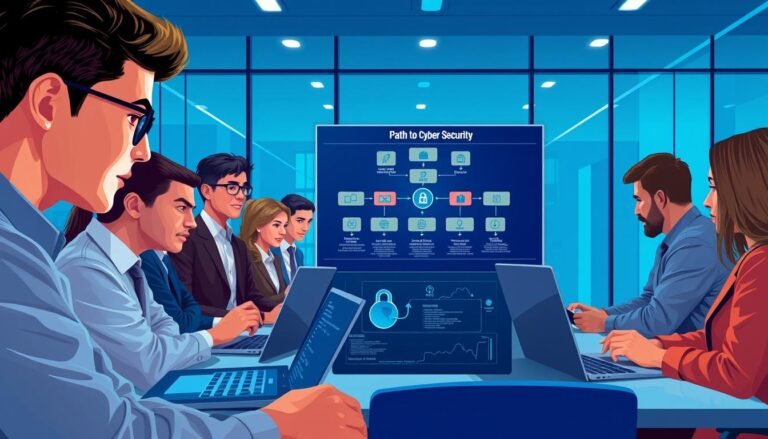
Cyber Security Best Practices to Protect Your Business
In our digital age, your business relies on online tools and connected systems every day. This increases exposure to threats that target sensitive data and operations.
Protecting your organization means a clear plan that covers access control, device management, and strict policies for handling information. Simple steps like strong passwords, regular updates, and encryption reduce risk and keep networks more resilient.
Small companies and large organizations share the same challenge: attackers look for weak points. Training employees and using the right tools helps stop many common attacks before they cause harm.
Over time, a layered approach makes operations safer. We’ll walk through practical solutions that fit real workflows and budgets so you can protect sensitive data and maintain business continuity.
Understanding the Importance of Cyber Security Best Practices
Modern businesses must treat digital resilience as core to operations, not an afterthought.
Statista projects that global cybercrime costs will rise by $6.4 trillion from 2024 to 2029. That number shows how much is at stake for companies of every size.
- Protect reputation and revenue: A single attack can erode customer trust and hit the bottom line.
- Manage data and access: Good management of accounts, software, and cloud systems lowers overall risk.
- Policy and training: Clear policies help employees spot threats and respond quickly.
Adopting solid cybersecurity measures lets organizations keep operations running and safeguard critical information. Treating this as a business priority makes recovery faster and losses smaller.
| Item Name | Description | Calories | Price |
|---|---|---|---|
| Starbucks Brew | Regular brewed coffee | 5 | $2.45 |
| Chick‑fil‑A Salad | Grilled chicken salad | 270 | $7.99 |
| Panera Sandwich | Turkey avocado sandwich | 520 | $8.49 |
Common Threats Facing Modern Organizations
Every day, digital threats shift tactics, and organizations must spot new hazards quickly.
Phishing attacks remain a top threat. Attackers use deceptive emails to trick employees into revealing credentials or giving access to internal systems. Simple user training and email filters cut risk dramatically.
Phishing Attacks
Fraudulent messages often impersonate partners or vendors. They aim to steal information or plant malicious software.
Ransomware
Ransomware can halt operations fast. A recent Microsoft systems upgrade failure disrupted air traffic control and affected over 3,000 U.S. flights, showing how system issues cascade.
The average cost of a data breach reached $4.88 million in 2024, so outages and breaches have heavy financial impact.
Insider Threats
Insider threats—intentional or accidental—put sensitive data at risk. Strong access management and device controls limit damage from compromised accounts.
- Quick wins: train staff, enforce access controls, and keep software patched.
- Focus: protect data, monitor network activity, and plan response steps.
| Item Name | Description | Calories | Price |
|---|---|---|---|
| Starbucks Brew | Regular brewed coffee | 5 | $2.45 |
| Chick‑fil‑A Salad | Grilled chicken salad | 270 | $7.99 |
| Panera Sandwich | Turkey avocado sandwich | 520 | $8.49 |
Strengthening Access Control and Authentication
Strong control over accounts and logins keeps sensitive data out of the wrong hands. Clear access rules and solid verification cut the chance of unauthorized entry into your systems.
Implementing multi-factor authentication adds a second layer beyond a password. This greatly lowers risk from stolen or weak passwords.
Practical steps for safer access
- Enable multi-factor authentication for all user accounts that access company data.
- Enforce strict password policies and use password managers to reduce weak passwords.
- Apply role-based access control so employees only see what they need for their roles.
- Deploy advanced authentication tools to protect critical systems and monitor unusual logins.
Studies show 81% of data breaches start with poor password security. For most businesses, combining strong passwords, MFA, and role limits gives significant protection.
| Item Name | Description | Calories | Price |
|---|---|---|---|
| Starbucks Brew | Regular brewed coffee | 5 | $2.45 |
| Chick‑fil‑A Salad | Grilled chicken salad | 270 | $7.99 |
| Panera Sandwich | Turkey avocado sandwich | 520 | $8.49 |
Protecting Data Through Encryption and Backups
When systems go down, encrypted archives and tested backups let you get back to work. Strong encryption keeps sensitive information unreadable, while solid backup routines keep copies safe from loss or ransomware.

Encryption standards: Use modern ciphers such as AES-256 for stored data and TLS 1.2+ for data in transit. Encrypt databases, endpoint drives, and backups so that stolen devices or drives yield no usable information.
The importance of regular backups: Follow the 3-2-1 rule: keep 3 copies of data, on 2 different storage types, with 1 copy off-site. Automate backups and include versioning so you can restore to points before an attack or failure.
Test restores regularly. Automated solutions that combine encryption with backup management lower recovery time and reduce operational risk.
| Item Name | Description | Calories | Price |
|---|---|---|---|
| On‑Site Backup | Local NAS with nightly snapshots | 0 | $499 |
| Off‑Site Archive | Encrypted cloud vault, geo-redundant | 0 | $0.02/GB |
| Encrypted Drive | Hardware-encrypted external SSD | 0 | $129 |
| Backup Software | Automated backups with version control | 0 | $199/year |
Securing Networks and Hardware
A single exposed device on a network can open doors to data loss and downtime.
Start with your network edge: deploy firewalls and traffic monitoring to block unauthorized access and spot unusual behavior quickly.
Keep all hardware configured with secure defaults. Enforce device hardening and limit administrative accounts to reduce vulnerabilities.
Protect against service-disrupting attacks by using rate limits, DDoS mitigation tools, and redundant links so your systems keep running during an event.
- Apply regular software updates to routers, switches, and endpoints to fix known gaps.
- Use centralized management for patching and inventory so devices stay current.
- Combine network controls with endpoint encryption and off-site backup to safeguard information.
Layered defense reduces risk: when physical hardware and the network are both locked down, breaches are much harder to pull off. Good management and routine checks keep your business resilient.
| Item Name | Description | Calories | Price |
|---|---|---|---|
| On‑Site Firewall | Perimeter firewall with traffic logging | 0 | $1,299 |
| Managed Switch | Layer 3 switch with access control lists | 0 | $749 |
| Endpoint Patch Service | Automated patch management for devices | 0 | $199/year |
Building a Security-First Culture
A culture that treats protection as everyone’s job changes how teams act day to day.

Human error drives many incidents. According to Verizon’s data breach investigation report, 74% of breaches involve human elements.
That makes training and clear policies a top priority. Regular sessions help employees spot phishing, social engineering, and other threats before damage happens.
Employee Training and Awareness
Start with short, practical training that covers passwords, device care, and how to report suspicious activity.
- Run monthly bite-sized modules so learning sticks.
- Simulate phishing to measure readiness and improve response.
- Reward compliance and praise quick reporting to encourage good behavior.
- Define roles so every user knows what data and access they control.
Open communication and ongoing refreshers reduce risk and make your business more resilient. When staff feel responsible and supported, they become the first line of defense for sensitive information.
| Item Name | Description | Calories | Price |
|---|---|---|---|
| Starbucks Brew | Regular brewed coffee | 5 | $2.45 |
| Chick‑fil‑A Salad | Grilled chicken salad | 270 | $7.99 |
| Panera Sandwich | Turkey avocado sandwich | 520 | $8.49 |
| On‑Site Backup | Local NAS with nightly snapshots | 0 | $499 |
Managing Third-Party and Cloud Risks
When partners host parts of your stack, you need clear rules for access, monitoring, and recovery.
More than half of enterprise IT spend is moving to cloud platforms by 2025, so managing cloud risk is now a core part of operations.
Third-party vendors can introduce vulnerabilities. Assess vendor controls before granting them access to systems or sensitive data.
- Require written policies and compliance evidence from vendors.
- Limit vendor access with role-based accounts and short-lived credentials.
- Monitor vendor activity continuously and log all access to critical resources.
Cloud environments differ from on-premises in how data is shared, how identity is handled, and where responsibility lies. Adopt cloud-native tools for encryption, identity management, and network segmentation.
| Item Name | Description | Calories | Price |
|---|---|---|---|
| Vendor Assessment | Third-party audits, SOC reports, contract clauses | 0 | $0 (internal process) |
| Access Controls | Role-based accounts and short-lived keys | 0 | $149/year |
| Continuous Monitoring | Log aggregation and anomaly detection | 0 | $299/month |
Proactive management prevents many breaches that start with a trusted partner. Make vendor risk part of your regular risk reviews and tie third-party obligations to your incident response plans.
Conclusion
Small, steady improvements to how you manage devices and access yield big gains in resilience.
Take action: set clear policies, run short training sessions, and schedule regular audits to keep your data and information safe.
Combine practical solutions—strong access controls, encrypted backups, and network monitoring—to reduce risk across systems. Treat maintenance and response as ongoing management tasks, not one-time items.
Start today by auditing your systems and getting your team involved. When businesses commit to these steps, organizations can better withstand evolving cyber threats and protect what matters most.
FAQ
What are the most important steps my business should take to reduce cyber risks?
Start with strong user access controls—unique accounts, role-based permissions, and multi-factor authentication (MFA). Keep operating systems and software updated, enforce robust password policies, encrypt sensitive data at rest and in transit, and maintain regular, tested backups. Combine those technical measures with employee training and clear incident response plans.
How does multi-factor authentication (MFA) help protect accounts?
MFA adds a second proof point beyond a password, like a push notification, hardware token, or SMS code. That extra layer blocks most automated attacks and credential-stuffing attempts, since an attacker rarely holds both the password and the second factor.
What are common threats modern organizations face?
Key threats include phishing attacks that trick users into revealing credentials, ransomware that encrypts files for ransom, and insider risks where employees or contractors unintentionally—or deliberately—expose data. Network vulnerabilities and unpatched systems also remain frequent attack vectors.
How can we defend against phishing effectively?
Combine technical controls—email filtering, domain-based message authentication (DMARC/DKIM/SPF), and link scanning—with ongoing user awareness training and simulated phishing tests. Make it easy for staff to report suspicious messages and respond quickly to reports.
What encryption standards should organizations use?
Use strong, widely accepted standards: AES-256 for data at rest and TLS 1.2+ (preferably TLS 1.3) for data in transit. For file-level or disk encryption, rely on vetted implementations from Microsoft BitLocker, Apple FileVault, or reputable third-party tools.
How often should backups be performed and tested?
Backups should follow a schedule that matches your business needs—daily for critical systems, weekly for less critical data. Crucially, test restores regularly (at least quarterly) to confirm backups are usable and to measure recovery time and data loss tolerance.
What role does employee training play in reducing risk?
Training turns people from weak links into frontline defenders. Regular sessions that cover phishing recognition, safe device use, and data handling rules reduce human error. Combine short microlearning modules with hands-on simulations for better retention.
How should businesses manage third-party and cloud risks?
Vet vendors with security questionnaires, require contractual security controls and audit rights, and limit third-party access using least-privilege principles. For cloud services, enable strong account controls, logging, and encryption, and monitor configurations against benchmarks like CIS.
What immediate steps should I take if a breach is suspected?
Isolate affected systems to stop spread, preserve logs and evidence, notify internal incident responders and leadership, and engage external experts if needed. Communicate clearly with stakeholders and follow legal or regulatory breach notification requirements.