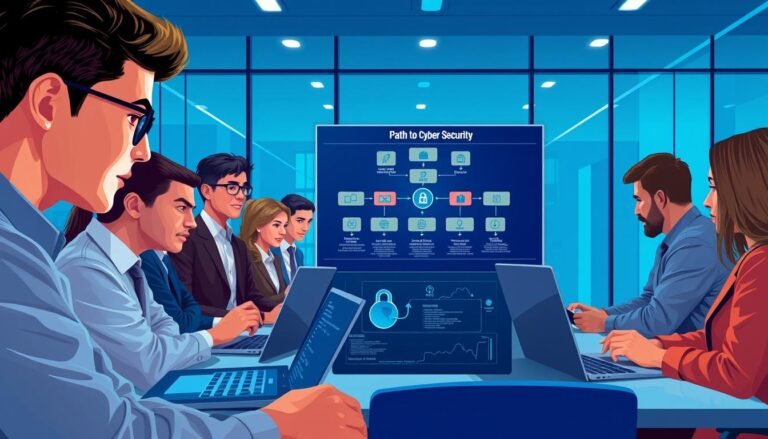
Masters in Cyber Security: Elevate Your Skills with a Graduate Degree
Ready to take your tech career further? Earning a masters in cyber security gives you focused, advanced training to protect critical systems and data in a digital world.
The master degree program blends technical labs with policy and management lessons. You learn software design, network architecture, and incident response while building real experience.
This cybersecurity program is flexible for working students. It offers options for credits, tuition aid, and ways to balance study with a job.
Our curriculum and faculty aim to prepare you for a rewarding career. You gain the practical skills and strategic thinking needed to lead teams and protect an organization from evolving threats.
Start your graduate study with a clear plan: choose courses that match your goals, review admission steps, and explore funding options to make the path doable and affordable.
The Growing Demand for Cybersecurity Expertise
The job market now rewards people who can defend complex information systems. The Bureau of Labor Statistics predicts a 33% increase in cybersecurity-related job postings by 2033, which means strong demand for trained professionals across the United States.
Organizations face constant threats, so a graduate degree and focused program are more valuable than ever. You learn to build policies, manage networks, and protect data using current technology and software tools.
- Hands-on experience with incident response and data protection.
- Knowledge of cloud and network topics that match industry needs.
- Management strategies to secure an organization’s information systems.
Students get one-on-one support from faculty to simplify admission and complete the degree on time. With rising costs of cybercrime, your skills will matter more across private industry and government roles.
| Item Name | Description | Calories | Price |
|---|---|---|---|
| Program Overview | Technical and management courses for real-world defense | 0 | $1,200 |
| Capstone | Hands-on project simulating incident response | 0 | $500 |
| Faculty Mentoring | One-on-one guidance during admission and study | 0 | Included |
Why Pursue a Masters in Cyber Security
A focused graduate degree can shift your role from technical lead to strategic leader within months. With an average of 15 years of experience, our students come to the program to gain advanced skills that drive real career advancement.
Career Advancement
Move into leadership. The curriculum prepares you for roles like Chief Information Security Officer and Cybersecurity Manager. You gain management tools, policy writing practice, and risk oversight experience that hiring teams value.
Deepening Technical Expertise
Master complex topics. Courses cover cryptography, secure software design, and advanced network systems. Capstone projects let you apply theory in scenarios that mirror industry incidents and threats.
- Collaborate with seasoned professionals to solve real-world problems.
- Build a portfolio that shows tangible experience to employers.
- Learn from faculty who bring years of industry insight to the classroom.
| Item Name | Description | Calories | Price |
|---|---|---|---|
| Program Overview | Technical and leadership courses for experienced professionals | 0 | $1,200 |
| Capstone | Industry-style project that builds employer-ready experience | 0 | $500 |
| Faculty Mentoring | One-on-one guidance and career advice | 0 | Included |
Core Curriculum and Technical Foundations
These core classes give you practical tools to protect an organization’s information assets.
The curriculum covers network defense, risk management, and incident response protocols. You will learn to secure computer systems and protect data across cloud and on-prem environments.
Courses teach secure software design and how to add protection early in the development life cycle. That makes your work more effective and lowers long-term cost for an organization.
- Hands-on labs for threat detection and response.
- Policy and information assurance to manage organizational risk.
- Practical projects that build professional experience.
| Item Name | Description | Calories | Price |
|---|---|---|---|
| Core Program | Network, risk, incident response coursework | 0 | $1,200 |
| Software Topics | Secure design and development practices | 0 | $500 |
| Faculty Mentoring | Guidance on projects and career steps | 0 | Included |
By finishing these core courses, students gain the foundational knowledge to move into specialized tracks and lead technical teams within industry.
Specialized Tracks for Advanced Learning
Specialized study lets you go deeper into evidence analysis, resilient design, or enterprise risk. Each track helps you build practical skills and a focused portfolio that employers value.
Digital Forensics
Learn to collect and analyze digital evidence. You practice data recovery, chain-of-custody procedures, and legal reporting to support incident response.
Secure Systems Design
This track teaches resilient architecture and secure software practices. You will design systems that reduce vulnerabilities and protect critical data and information systems.
Risk Management
Focus on evaluating enterprise threats, compliance, and mitigation strategies. You learn to translate technical findings into actionable management decisions.
- Industry-led courses bring real-world examples and tools.
- Project work simulates complex problems and builds experience.
- Flexible pacing lets you balance work, credits, and time.
| Item Name | Description | Calories | Price |
|---|---|---|---|
| Digital Forensics Track | Evidence collection, analysis, and legal reporting | 0 | $1,300 |
| Secure Systems Design Track | Resilient architecture and secure software practices | 0 | $1,400 |
| Risk Management Track | Threat assessment, compliance, and mitigation methods | 0 | $1,200 |
Hands-on Experience and Capstone Projects
Capstone projects turn classroom knowledge into tangible results for real organizations. You join industry-backed teams that tackle a defined threat or operational challenge. This hands-on work proves your skills and gives employers a clear view of your abilities.
Throughout the program, you work with faculty mentors and peers to shape a proposal, run tests, and deliver a final presentation. The curriculum builds practical exercises into every course so you practice methods on real systems and data.
- Real projects: Partner with industry to solve an actual problem.
- Teamwork: Collaborate with students and faculty to manage scope and timelines.
- Tools and labs: Use current technology and software in a safe environment.
- Portfolio-ready: Finish with a tangible deliverable that supports your career goals.
| Item Name | Description | Calories | Price |
|---|---|---|---|
| Capstone Project | Industry partner problem, end-to-end solution | 0 | $500 |
| Lab Access | State-of-the-art technology and software tools | 0 | Included |
| Faculty Mentoring | Ongoing feedback from experienced instructors | 0 | Included |
Flexibility in Online Graduate Education
An online graduate path lets you fit advanced study around your daily job and family life. The University of Wisconsin Master of Science in Cybersecurity is 100% online, so you can study on your own schedule and keep working full time.

Balancing Work and Study
Our program is built for busy professionals. Courses are available anytime, so students can access lectures, complete assignments, and join discussions when it suits their hours.
You get the same high-quality education and degree as on-campus peers. Faculty support, online forums, and collaborative projects recreate a strong classroom experience.
- Structured terms with clear expectations help you plan credits and finish on schedule.
- Remote access saves on commuting and relocation, cutting cost and time burdens.
- Hands-on projects develop time management and practical skills that apply to workplace systems and data challenges.
| Item Name | Description | Calories | Price |
|---|---|---|---|
| Online Program Access | 24/7 course materials and forums | 0 | $1,200 |
| Term Structure | Clear schedules to balance work and study | 0 | $500 |
| Student Support | Faculty mentoring and peer collaboration | 0 | Included |
Choose an online master degree to keep your career on track while you gain advanced knowledge in cybersecurity and security management.
Admission Requirements and Prerequisites
Before you apply, learn which documents and experiences most strengthen an application for a master degree program.
Admission to our master degree program ensures students have the basics to handle advanced coursework. Reviewers look for academic readiness and relevant professional experience.
For selective programs like the Harvard ALM, performance-based admissions are required. You will demonstrate your ability to complete rigorous tasks before full enrollment.
- Academic record: transcripts showing computer science, information technology, or related coursework.
- Professional proof: resume that highlights technical roles and project work.
- Prerequisites: specific course work or bridge courses if your background is non-technical.
| Item Name | Description | Calories | Price |
|---|---|---|---|
| Application Packet | Resume, transcripts, personal statement | 0 | $50 |
| Performance Review | Timed tasks or project submission (Harvard ALM style) | 0 | $0 |
| Prerequisite Course | Intro to networks or programming if needed | 0 | $400 |
Our enrollment counselors help you interpret requirements, estimate credits, and plan tuition or funding. Meeting these standards places you with a cohort ready to protect information and systems and move forward in your career.
Financial Aid and Tuition Considerations
You don’t have to cover tuition alone; several funding streams make the program accessible. Our team walks you through grant options, federal aid, and employer plans so you can plan costs with confidence.
Grant Funding
Grant funding and scholarships reduce out-of-pocket cost for students pursuing a master degree in cybersecurity. Many awards consider professional experience and prior coursework when deciding grants.
Employer Reimbursement
Employer reimbursement is a common path. Organizations often cover tuition or offer partial reimbursement when the course aligns with job duties.
- We provide clear cost breakdowns so you can plan credits and term budgets.
- Our financial aid office helps match you with grants and federal aid options.
- Leveraging employer programs can lower debt and speed career return on investment.
| Item Name | Description | Calories | Price |
|---|---|---|---|
| Grant Funding | Need- and merit-based awards for eligible students | 0 | $0 |
| Employer Reimbursement | Tuition support from current employer tied to work agreement | 0 | Varies |
| Federal Aid | Loans and grants to cover tuition and living costs | 0 | Available |
Next steps: contact our financial aid office to compare options and estimate total tuition. With the right mix of aid, you can focus on building the skills and experience that protect information systems and advance your career.
Career Opportunities and Salary Potential
Earning a master degree opens doors to high-pay roles across healthcare, finance, and government. Employers seek professionals who can protect data and lead teams that defend critical information systems.
You may qualify for advanced titles like Chief Information Security Officer, Cybersecurity Architect, or Security Manager. Those roles combine technical know-how with management and often come with strong salary ranges.

Our program helps you build leadership and technical experience that employers value. Career services connect students with top firms and government agencies, and alumni work at major companies that hire program graduates.
- Leadership growth: present risks clearly and guide teams.
- Practical skills: show real projects and measurable outcomes.
- Job stability: demand for trained professionals continues to rise.
| Item Name | Description | Calories | Price |
|---|---|---|---|
| Career Coaching | Resume, interview prep, employer introductions | 0 | Included |
| Alumni Network | Connections at Fortune 500 and federal agencies | 0 | Included |
| Salary Outcomes | Advanced roles often see large increases vs. entry-level pay | 0 | Varies |
Industry Certifications and Professional Development
Certifications bridge classroom learning and workforce demands by proving applied competence. They add a clear stamp of readiness to your academic record and help you move from study to job faster.
Value of Industry Credentials
Our cybersecurity master program integrates industry exams like the (ISC)² Certified in Cybersecurity (CC) so you earn both academic and professional validation.
- Exam-ready coursework: courses teach the practical skills needed to pass vendor tests.
- Cost support: we provide vouchers for many certification exams to help manage cost.
- Career impact: credentials show mastery of key security domains and boost marketability.
- Ongoing development: faculty-led study groups and expert instructors keep your knowledge current.
| Item Name | Description | Calories | Price |
|---|---|---|---|
| Certification Vouchers | Exam vouchers for select industry credentials | 0 | Included |
| Prep Courses | Targeted review aligned with certification domains | 0 | Included |
| Faculty Support | Mentoring and study groups for exam readiness | 0 | Included |
Graduates leave with a master degree and industry credentials. That combo gives hiring teams confidence in your information handling and systems experience.
Comparing Traditional and Accelerated Programs
When choosing a program, weigh how fast you want to finish versus how much structure you need.
WGU is ranked #6 best online cybersecurity master’s program by Fortune, and it offers an accelerated path for students who can move quickly through material.
Accelerated tracks let you complete a degree as soon as you master the course work, often in under two years. They give you control over your timeline and can speed career progress.
Traditional programs usually follow a set semester schedule with professor-led classes. That model works well if you prefer fixed deadlines, group projects, and regular contact with instructors.
- Compare total cost: tuition plus the price of industry certification exams.
- Decide if independent study or a cohort-based classroom fits your learning style.
- Factor in flexibility—working professionals often favor self-paced online options.
| Item Name | Description | Calories | Price |
|---|---|---|---|
| Accelerated Program | Self-paced course load, finish faster if you demonstrate mastery | 0 | $1,200 |
| Traditional Program | Semester schedule, professor-led classes, cohort learning | 0 | $1,400 |
| Certification Costs | Industry exam fees that may add to total tuition | 0 | $300 |
| Advising Support | Guidance to compare programs and plan finances | 0 | Included |
Bottom line: pick the path that matches your schedule, learning style, and budget. Whether you choose the accelerated route or a traditional model, both can deliver the skills you need to advance in cybersecurity.
Preparing for Your Future in Information Security
A long-term focus on learning will keep your skills current and your career moving forward.
Commit to continuous learning. Track new threats, test defensive tools, and refresh core concepts regularly so your work stays relevant.
Explore funding options early. Apply for financial aid where eligible to reduce stress and keep focus on study and projects.
- Use your degree as a foundation for leadership and technical roles.
- Build a professional network with peers, mentors, and employers.
- Stay proactive: attend workshops, join forums, and share practical work.
| Item Name | Description | Calories | Price |
|---|---|---|---|
| Learning Plan | Structured schedule for coursework and hands-on labs | 0 | $0 |
| Funding Guide | Steps to apply for financial aid and employer aid | 0 | $50 |
| Mentor Program | Connections to industry mentors and alumni | 0 | Included |
| Career Portfolio | Capstone projects and certifications to show ability | 0 | $500 |
We are here to support you with resources and guidance so you can complete your degree and seize the opportunities ahead.
Conclusion
Finish strong: your master degree can bridge hands-on work and strategic roles that shape how organizations protect data.
Our cybersecurity master offers a mix of practical projects and leadership training so you leave ready to lead teams and solve real threats.
Flexible pacing and financial aid make this degree doable while you keep working. You can choose online or cohort formats that fit your life.
Join a community of practitioners and mentors who help you grow. Take the next step and start your journey toward a career that matters.
FAQ
What can I expect from a graduate program focused on cybersecurity?
You’ll build technical skills across networks, systems, software, and data protection while learning management, incident response, and policy. Programs blend lectures, labs, and capstone projects to give hands-on experience that prepares you for roles in operations, architecture, and risk management.
How long does a typical master’s degree take to complete?
Most full-time programs run 12–24 months depending on credits and whether you choose an accelerated track. Part-time or online options can stretch to 2–4 years to accommodate work and life commitments.
What core topics are usually covered in the curriculum?
Courses typically include network defense, cryptography, secure systems design, digital forensics, threat modeling, and governance. You’ll also study applied labs, incident handling, and elective specializations such as risk management or forensics.
Are there specific admission requirements I should know about?
Common prerequisites include a bachelor’s degree in computing or related field, GRE scores if required, transcripts, letters of recommendation, and sometimes foundational coursework in programming, networking, or operating systems.
What kinds of financial aid or tuition help are available?
Financial aid options include federal student loans, scholarships, university grants, and employer tuition reimbursement. Some schools offer assistantships that reduce tuition in exchange for teaching or research support.
How do capstone projects and labs benefit my career prospects?
Capstones simulate real-world incidents and require you to design, implement, and defend solutions. These projects showcase practical expertise to employers and often align with industry practices and tools they use daily.
Can I work full time while studying online?
Yes. Many programs offer asynchronous coursework and evening or weekend labs to help you balance work and study. Choose programs with flexible pacing and strong student support if you plan to keep working.
How do specialized tracks like digital forensics or risk management differ?
Digital forensics focuses on evidence collection and analysis, while risk management emphasizes policies, frameworks, and compliance. Secure systems design centers on building resilient architectures and secure software practices.
Will a graduate degree help me earn industry certifications?
Definitely. Graduate programs often align with certifications such as CISSP, CEH, and CompTIA Security+. Coursework, labs, and faculty guidance can accelerate your preparation for these credentials.